
How Nollywood Became a Multi-Billion Dollar Industry — The Real Numbers Explained
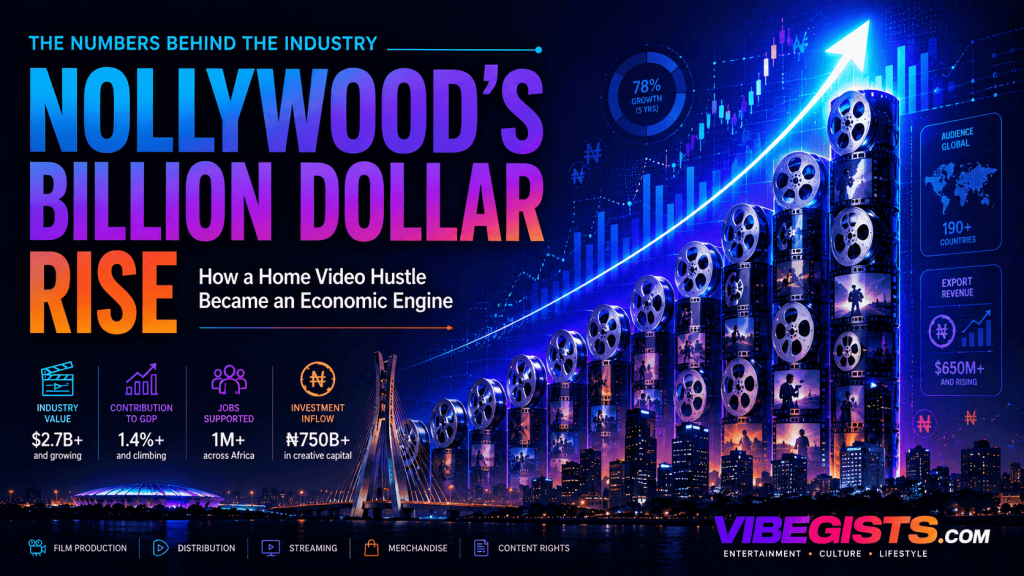
There’s a number that gets repeated a lot in conversations about Nigerian entertainment, usually without much context: Nollywood is the second-largest film industry in the world by volume. It sounds impressive, and it is, but volume alone doesn’t tell you much about money, jobs, or actual economic weight. The more interesting question — and the one that matters if you’re trying to understand Nollywood’s economic impact on Nigeria’s GDP — is what happens when you follow the money instead of just counting the films.
The answer turns out to be a genuinely remarkable business story, one that most people, including many Nigerians, don’t fully appreciate.
From Informal Hustle to Counted GDP Sector
For most of its existence, Nollywood operated almost entirely in the informal economy. Films were shot quickly, distributed through home video markets, and sold through a network of marketers who financed productions in exchange for distribution rights. There were no studios in the traditional Hollywood sense, no formal contracts in most cases, and certainly no line item in Nigeria’s national accounting for “movies.”
That changed in a meaningful way in 2014, when Nigeria conducted a GDP rebasing exercise — essentially an update to how the national economy is measured to reflect sectors that had grown but were never properly counted. Nollywood, alongside the technology sector, music industry, and telecommunications, was included in Nigeria’s GDP calculations for the first time. The effect was staggering on paper: Nigeria’s GDP estimate jumped from roughly $285.5 billion to $510 billion almost overnight, simply because previously invisible sectors were finally being measured.
That rebasing didn’t create new wealth. It revealed wealth that was already there, hiding in plain sight inside an industry built on hustle and word-of-mouth distribution.
The Numbers Today
Once Nollywood started being properly tracked, the figures told an increasingly impressive story. By 2021, Nigeria’s film industry was contributing approximately 2.3% to national GDP, translating to roughly $660 million. By 2023, the broader entertainment and media sector — film, music, arts, and recreation combined — had grown to contribute around $1.4 billion, or close to 1.72% of total GDP.
Industry projections for the Nigerian creative economy, driven primarily by Nollywood and Afrobeats, suggest the sector could reach somewhere between $10.8 billion and $14.8 billion in annual revenue depending on which analysis you’re reading, with some forecasts placing the broader entertainment and media sector at nearly $13.9 billion by 2027.
Box office numbers specifically have shown sharp year-on-year growth. Nigerian cinema revenue reportedly surged by 125% in a single recent year, crossing ₦3.5 billion (roughly $76 million USD) at the box office — and that’s measuring formal theatrical releases alone, not the much larger volume of films that go straight to streaming or home distribution.
The Netflix Effect
A significant accelerant in Nollywood’s recent commercial maturation has been the entry of major international streaming platforms, with Netflix leading the charge. Netflix has publicly disclosed investing more than $23 million directly into the Nigerian film industry over a seven-year period, supporting over 5,140 jobs and enabling more than 250 locally licensed titles.
According to Netflix’s own reporting, that investment generated $39 million in contributions to Nigerian GDP, $34 million in household income, and $2.6 million in tax revenue. Those numbers matter because they represent something Nollywood historically lacked: formal, documented, traceable economic activity that government agencies and international investors can actually point to.
This is a meaningful shift from Nollywood’s earlier decades, when the industry’s informal structure — cash transactions, oral agreements, weak intellectual property protections — made it difficult for outside capital to engage confidently. Streaming platforms entering with formal contracts and licensing structures have effectively dragged a chunk of Nollywood’s economic activity out of the shadows and into measurable, bankable territory.
Employment Numbers That Rival Major Industries
Perhaps the most underappreciated statistic in this entire conversation is employment. Nollywood is widely cited as Nigeria’s largest employer after agriculture, with estimates suggesting over one million people work directly within the industry — actors, crew, editors, costume designers, marketers, and the vast support ecosystem that surrounds film production. Some industry projections suggested that figure could climb toward 2.7 million as digital platforms continued expanding access and demand.
For context, that’s an employment footprint comparable to entire formal sectors in much smaller economies. It represents an industry that, despite lacking the institutional infrastructure of Hollywood or Bollywood for most of its history, has organically built one of the largest creative employment bases on the planet.
Why This Matters Beyond the Numbers
It’s tempting to treat economic statistics as dry background noise next to the more exciting parts of entertainment coverage — the AMVCA wins, the celebrity drama, the box office records. But the economic story is arguably the more important one, because it explains why everything else is happening at the scale it is now.
International distributors paying attention to Nigerian content, increased production budgets, more ambitious storytelling, films like My Father’s Shadow reaching Cannes — none of that happens in a vacuum. It happens because the underlying economics of Nollywood have matured to the point where serious investment makes commercial sense. Money follows opportunity, and Nollywood has spent the last decade quietly proving it’s a legitimate one.
Nigeria’s government has set ambitious targets around this growth, with creative export goals tied to broader economic diversification plans that reduce dependence on oil revenue. Whether those most ambitious targets are hit on schedule is a separate question, but the underlying trend — an industry moving from informal hustle to formally counted economic powerhouse — is not in dispute.
The next time someone tells you Nollywood is just entertainment, you now have the receipts to explain why it’s a great deal more than that.
What do you think Nollywood needs most to keep this growth going — better funding, stronger piracy laws, or more international partnerships? Tell us in the comments.

You might also like
 The Untold History of Nollywood — From Living in Bondage to Global Streaming
 How Netflix Is Quietly Reshaping Nollywood — And What It Means for Nigerian Filmmakers
 Why Adsterra Is Better Than Google AdSense for New Bloggers in 2026
 Fela Kuti Wins Historic Grammy Lifetime Achievement Award — The Full Story
 Why Nigerian Afrobeats Artists Keep Losing the Grammy’s African Music Category — A Deep Dive
Leave a Reply