
How Netflix Is Quietly Reshaping Nollywood — And What It Means for Nigerian Filmmakers
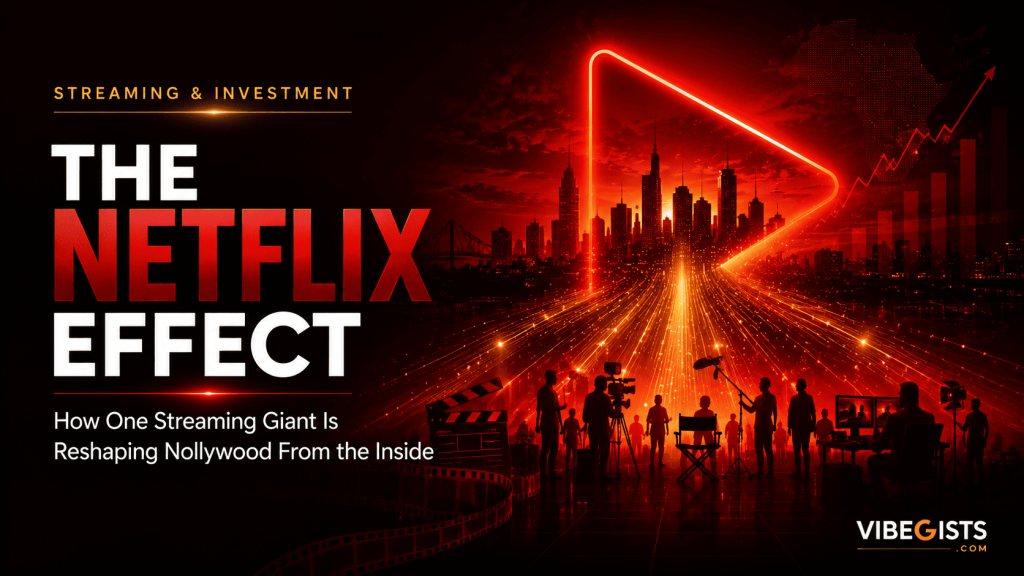
Netflix Nollywood investment impact
When Netflix first started licensing Nigerian films back in the late 2010s, the move was treated by a lot of industry observers as a curiosity — a global streaming giant testing the waters in an unfamiliar market, the way large companies sometimes dip into emerging regions without much long-term commitment. That read has aged poorly. Netflix’s Nollywood investment has turned into one of the more consequential financial relationships in recent Nigerian entertainment history, and the actual numbers behind it are worth examining closely.
The Investment, By the Numbers
Netflix has publicly disclosed investing more than $23 million directly into Nigeria’s film industry over a seven-year period. That investment supported over 5,140 jobs and made possible more than 250 locally licensed titles available on the platform. According to Netflix’s own economic impact reporting, that spending generated approximately $39 million in contributions to Nigerian GDP, roughly $34 million in household income for workers connected to the productions, and around $2.6 million in tax revenue for the Nigerian government.
These aren’t enormous numbers by the standards of Netflix’s total global content budget, which runs into the tens of billions of dollars annually. But within the specific context of Nollywood’s historically informal, undercapitalized production environment, this kind of structured, documented foreign investment represents something genuinely new.
What Changed for Filmmakers
The most immediate and tangible shift for Nigerian filmmakers working with Netflix has been access to formal contracts and significantly larger production budgets than the traditional Nollywood marketer-financing model typically allowed. A film financed through the old system might be shot in a matter of days with a budget calculated in single-digit millions of naira. A Netflix original commission operates on an entirely different financial scale, with corresponding expectations around production values, post-production quality, and timeline discipline.
This has created two parallel tracks within the industry. There’s still a thriving, high-volume commercial Nollywood that produces films quickly and cheaply for domestic theatrical and home audiences, operating much as it always has. And increasingly, there’s a smaller but growing tier of Nigerian filmmakers working on Netflix-backed or Netflix-distributed projects, with access to bigger budgets, longer production schedules, and international audience reach that the traditional model couldn’t offer.
Films like Citation, Òlòtūré, King of Boys, and The Black Book represent this newer tier — Nigerian stories told with bigger resources and aimed at both domestic and genuinely global audiences simultaneously, rather than choosing one market over the other.
The Trade-Offs Worth Discussing Honestly
It would be incomplete to present this relationship as purely beneficial without examining its more complicated dimensions. Streaming platforms, including Netflix, retain significant creative and commercial control over the projects they finance, which means decisions about what gets greenlit increasingly run through the preferences of a foreign corporation’s content strategy rather than purely through Nigerian creative or commercial instincts.
There’s also a legitimate conversation within the industry about whether the prestige and resources associated with streaming deals are creating a two-tier system that risks devaluing the traditional, fast-moving commercial Nollywood that built the industry’s massive employment base in the first place. Not every Nigerian filmmaker wants or needs a Netflix deal, and the platform’s involvement, while financially significant, still touches a relatively small percentage of the roughly 2,500 films Nigeria produces annually.
A Net Positive for the Industry’s Global Profile
Whatever the trade-offs, it’s difficult to argue against the broader visibility Netflix’s involvement has generated for Nigerian cinema internationally. Films that previously might have struggled to reach audiences outside Nigeria and its diaspora communities are now available to subscribers across more than 190 countries. That distribution reach has played a meaningful role in introducing global audiences to Nigerian storytelling, Nigerian actors, and Nigerian directors who might otherwise have remained largely unknown outside the continent.
It has also, by extension, contributed to the broader international momentum that helped a film like My Father’s Shadow land at Cannes in 2025 — not because Netflix was directly involved in that specific film, but because the overall international appetite for Nigerian cinema that Netflix helped cultivate has made global institutions and audiences more receptive to Nigerian storytelling generally.
What Comes Next
Other streaming platforms, including Amazon Prime Video and South Africa’s Showmax, have followed Netflix’s lead to varying degrees, suggesting the streaming-Nollywood relationship is becoming a permanent and expanding fixture of the industry’s landscape rather than a temporary experiment.
For Nigerian filmmakers, the practical takeaway is that the industry now offers genuinely different paths depending on creative and commercial goals — the fast, high-volume, locally-financed traditional route, or the slower, better-resourced, internationally-distributed streaming route. Neither path is inherently superior, and the healthiest version of Nollywood’s future likely involves both continuing to coexist and feed into each other, the way they increasingly already do.
What’s clear is that Netflix’s entry into Nigerian filmmaking has moved well past the experimental phase. It’s now a structural part of how a meaningful slice of Nollywood gets financed, produced, and distributed — and the data suggests that relationship is only going to deepen from here.
Do you prefer big-budget Netflix Nollywood productions or the fast, raw energy of traditional commercial Nollywood? Tell us your take in the comments.

You might also like
 Fela Kuti Wins Historic Grammy Lifetime Achievement Award — The Full Story
 How Nollywood Became a Multi-Billion Dollar Industry — The Real Numbers Explained
 The Untold History of Nollywood — From Living in Bondage to Global Streaming
 Why Adsterra Is Better Than Google AdSense for New Bloggers in 2026
 Why Nigerian Afrobeats Artists Keep Losing the Grammy’s African Music Category — A Deep Dive
Leave a Reply